


Introducing the GR GT. A thoroughbred race machine built for the streets. A bold new flagship embodying GR’s driver-centered philosophy.
Toyota 2000GT, Lexus LFA, and now GR GT.
Born in the spirit of “Toyota’s Shikinen Sengu,” which is its own tradition of renewal, the GR GT is built to command an unmistakable presence.
The skills that must endure are passed on to the next generation. From the veterans who built the Lexus LFA to the next generation of engineers,
the core skills of car building are preserved even as new technologies evolve. The GR GT symbolizes this continual challenge.
Starting with Master Driver Morizo, and joined by professional drivers Tatsuya Kataoka, Hiroaki Ishiura, Naoya Gamou, and gentleman driver Daisuke Toyoda, engineers listened closely as these drivers pushed the car, understanding their intent with precision and shaping it into reality.
This united pursuit of a driver first philosophy between drivers and engineers has created a road car with the soul and precision of a true racing machine.
Features
Performance that rises above the rest, delivered at your command. Three core principles that sharpen the bond between driver and machine.
Discover the three principles that make it possible.
A low-center-of-gravity package
A low-center-of-gravity package


Lightweight, highly-rigid aluminum structure
Lightweight, highly-rigid aluminum structure


Aerodynamics shaped through a reverse-design approach.
Aerodynamics shaped through a reverse-design approach.


GR GT3 & Lexus LFA Concept


Lexus LFA
Concept


The entire development team came together to thoroughly discuss what each considered to be a truly amazing car, and the qualities that define it.
Because these discussions began even before the drivetrain had been determined, the team already shared a unified vision and sense of purpose as one team by the time the project officially began moving forward.
As development progressed, drivers continued to exchange views on the car’s behavior at the limit, and that ongoing dialogue steadily elevated the car to a higher level.

While its circuit performance is a given, the car also delivers a racing-car-inspired feel that can be genuinely experienced on public roads.
I hope people can drive it and experience it for themselves.
From the moment you get in and start the engine, even a brief drive is enough to reveal the car’s performance potential.
I believe it is a car that allows drivers to experience excitement and thrill with all five senses.

Above all, what mattered most was the ability to maintain constant dialogue with the car.
Every element, from seat position to the tire grip and road input conveyed through the steering wheel, was developed without compromise so that information could be relayed to the driver naturally.
As a result, the car can be controlled intuitively, as an extension of the driver’s own body.

At the same time, it was equally important to consider how closely amateur drivers could approach that level.
With this in mind, we conducted extensive testing together, working side by side with professional drivers throughout development.
By collaborating from the earliest stages, including planning and prototyping, we were able to address challenges as they arose, resulting in a highly capable vehicle.

”THE OVERTAKE”
The GR GT, GR GT3, and Lexus LFA Concept were born from the conviction of Toyota Motor Corporation (TMC) Chairman Akio Toyoda, aka Master Driver Morizo, that certain car-making skills must be preserved and passed on to the next generation. Together, the three models symbolize “Toyota’s Shikinen Sengu”.
Shikinen Sengu is a traditional Japanese shrine ritual during which a Shinto* shrine’s core structures and elements are rebuilt every few decades. The ritual involves not only rebuilding the shrine itself but also recrafting its furnishings and ceremonial garments housed within. As such, it serves as a platform for artisans of a wide range of traditional Japanese crafts—including architecture, blacksmithing, and weaving—to pass on their skills to the next generation.
The three unveiled models are being positioned as TMC’s flagship sports cars, in the footsteps of the Toyota 2000GT and Lexus LFA. They embody “Toyota’s Shikinen Sengu” through the making of sports cars by preserving and passing on to the next generation fundamental car-making skills and incorporating new technologies.
-Behind the Scenes-

History

The in-house design featured an ultra-low coupe body set over an X shaped backbone frame. A straight 6 DOHC 2000 cc engine, independent double wishbone suspension on all four corners, 4-wheel disc brakes, and magnesium alloy wheels were all firsts for a Japanese production car. Its performance stood
among the best in the world with a top speed of 220 km/h, 0-400 meters in 15.9 seconds, and 0-100 km/h in 8.6 seconds. Before it even reached the market, the 2000GT set 3 world records and 13 international records, proving its strength in races across Japan and the United States.

The CFRP (carbon fiber reinforced plastic) monocoque chassis carried a V-10 4.8-liter engine (LR GUE) co-developed with Yamaha Motor. As of April 2011, this engine delivered the strongest output of any Japanese production car, producing 412kW(560PS)*/8700rpm・470Nm(48.9kgm)/6800rpm. Its power flowed through a 2 pedal 6-speed ASG
(Automated Sequential Gearbox), driving the rear wheels through a transaxle that integrated the differential and gearbox. For optimal weight balance, the engine was mounted in a front midship layout, the transaxle sat at the rear, and the radiators were positioned to either side behind the rear wheels.
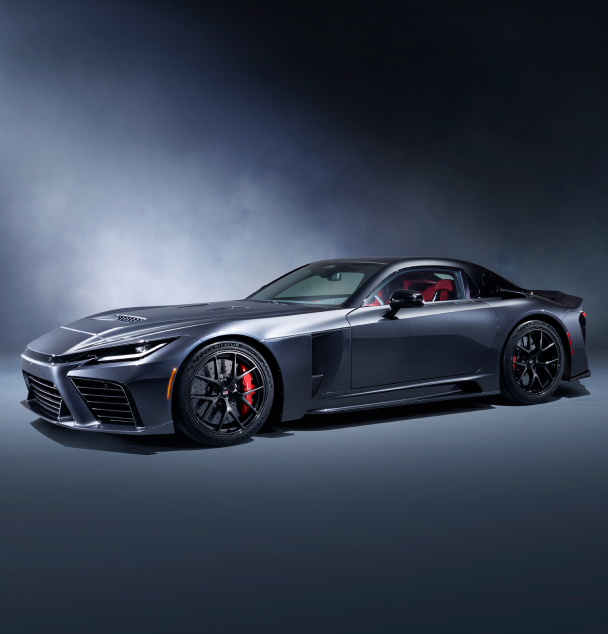
As the flagship sports car of GAZOO Racing, the GR GT was developed with one clear concept: a racing machine built for the road. In both sports cars and racing cars, performance is defined by raw dynamic ability, true machine fighting strength, and a driver-first focus that unites driver and car in a constant, living dialogue. The GR GT’s
newly developed 4L V-8 twin turbo engine and single motor hybrid system target over 650PS and more than 850Nm of torque. Along with that overwhelming performance, the car is built around 3 key elements: a low center of gravity, a lightweight and high rigidity structure, and aerodynamics refined for maximum effect.
